1. The Problem
IT support tickets and critical infrastructure incident reports were managed through informal WhatsApp groups and shared email inboxes. Urgent tickets were frequently buried, staff had no SLA tracking or escalation policies, and there was zero historical audit trail when equipment broke down. Additionally, server downtime often went unnoticed until a department head called to complain, resulting in an average mean-time-to-acknowledge (MTTA) of over 4 hours.
2. What I Built
I engineered a centralized incident management and e-ticketing platform built around a multi-stage deterministic state machine (`Open` → `Assigned` → `In Progress` → `Escalated` → `Resolved` → `Closed`). Every state transition records an immutable audit trail with timestamps, user agent hashes, and resolution notes. To eliminate notification delays, I integrated an SMS gateway API with an asynchronous queue worker that dispatches emergency SMS alerts to on-duty engineers when high-priority tickets are filed. I also wrote a lightweight Python/Bash systemd telemetry daemon that monitors server memory, disk usage, and HTTP endpoint health every 60 seconds, automatically raising an incident ticket if thresholds are breached.
3. Architecture & Technology Stack
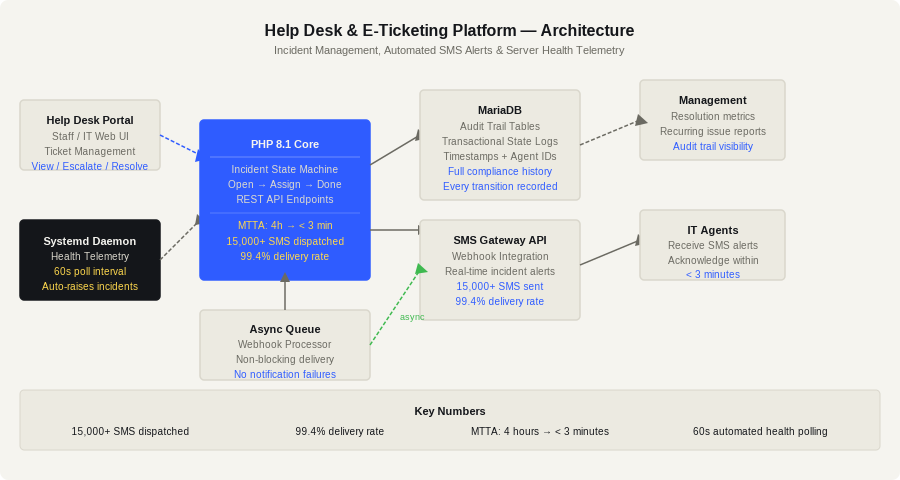
| PHP 8.1 MVC | State machine engine with CSRF token handshakes and audit trails |
| MariaDB / MySQL | Relational audit log tables with indexed foreign key cascading |
| SMS Gateway API | Webhook integration for real-time priority alerting (15,000+ sent) |
| Systemd Daemon | 60-second health check polling daemon monitoring server resources |
| NGINX | Strict security headers (CSP, HSTS, X-Frame-Options) and rate limiting |
| Linux / Bash | Automated backup scripts and alert forwarding daemons |
4. Results & Measurable Metrics
- Dispatched 15,000+ automated SMS notifications via gateway webhooks with a 99.4% delivery rate.
- Reduced mean-time-to-acknowledge (MTTA) for critical infrastructure alerts from 4 hours to under 3 minutes.
- Systemd health telemetry daemon eliminated manual daily server checks, proactively catching 12 resource warnings before outages occurred.
- 100% compliance audit trail established for over 3,200 closed IT support tickets.
- Queue-based webhook processor prevented notification drops during server write spikes.
5. What I'd Do Differently
In retrospect, running the health monitoring daemon as a local systemd service means that if the host server itself undergoes a catastrophic network failure, the monitor cannot send an alert. I would now implement an external synthetic ping service (like Uptime Kuma or Prometheus Alertmanager hosted on an independent offsite node) to provide heartbeat dead-man's switch alerting.